
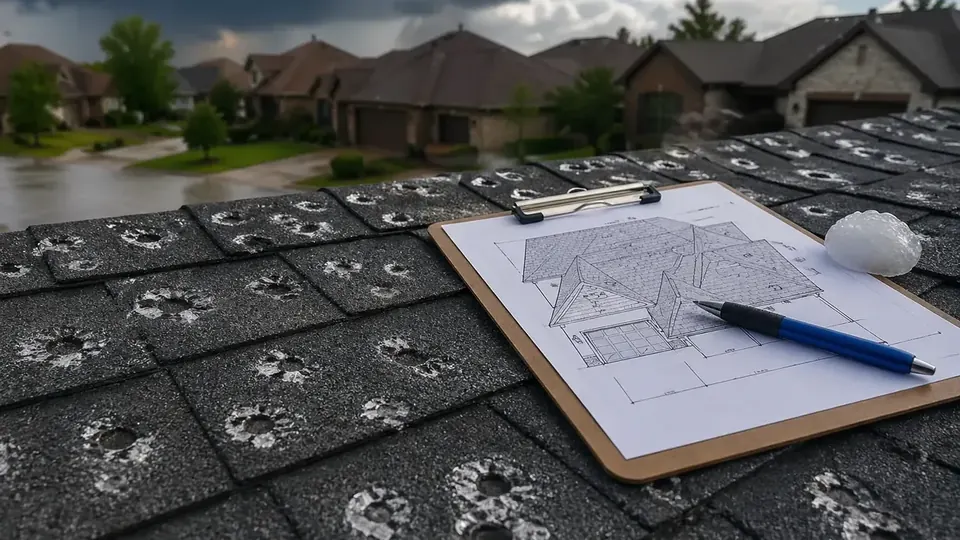
Port Arthur hail damage claims are less common than wind claims, but they can be just as costly. NOAA’s Storm Events Database records large hail in and around the city: 1.75-inch hail in Port Arthur on December 28, 2024 (NCEI event record), 2-inch hail in Groves on May 12, 2024 (NCEI event record), and 2.75-inch hail at Sabine Pass in April 2003. Because hail here arrives with fast-moving thunderstorm lines rather than every spring, many owners do not think to check their roofs afterward. The damage may only surface later as a leak, and by then the storm date is harder to prove.
What Hail Does to Port Arthur Properties
Hail damage depends on stone size, wind speed during the storm, and the age and type of material. Common damage includes:
- Composition shingles: bruises, granule loss, and fractured mats that shorten the roof’s life
- Metal roofs and buildings: dents in panels, trim, and ridge caps; damaged sealant at fasteners
- Low-slope commercial roofs: punctured or cracked membranes and crushed insulation boards
- Soft metals: gutters, downspouts, vents, flashing, and AC condenser fins
- Windows and siding: broken glass, torn screens, cracked vinyl siding, and chipped paint
- Skylights and outdoor equipment: cracked domes, damaged pool and HVAC equipment
For roof-specific issues such as repair vs. replacement and permits, see our roof damage insurance claims page.
Proving the Hail Storm Date
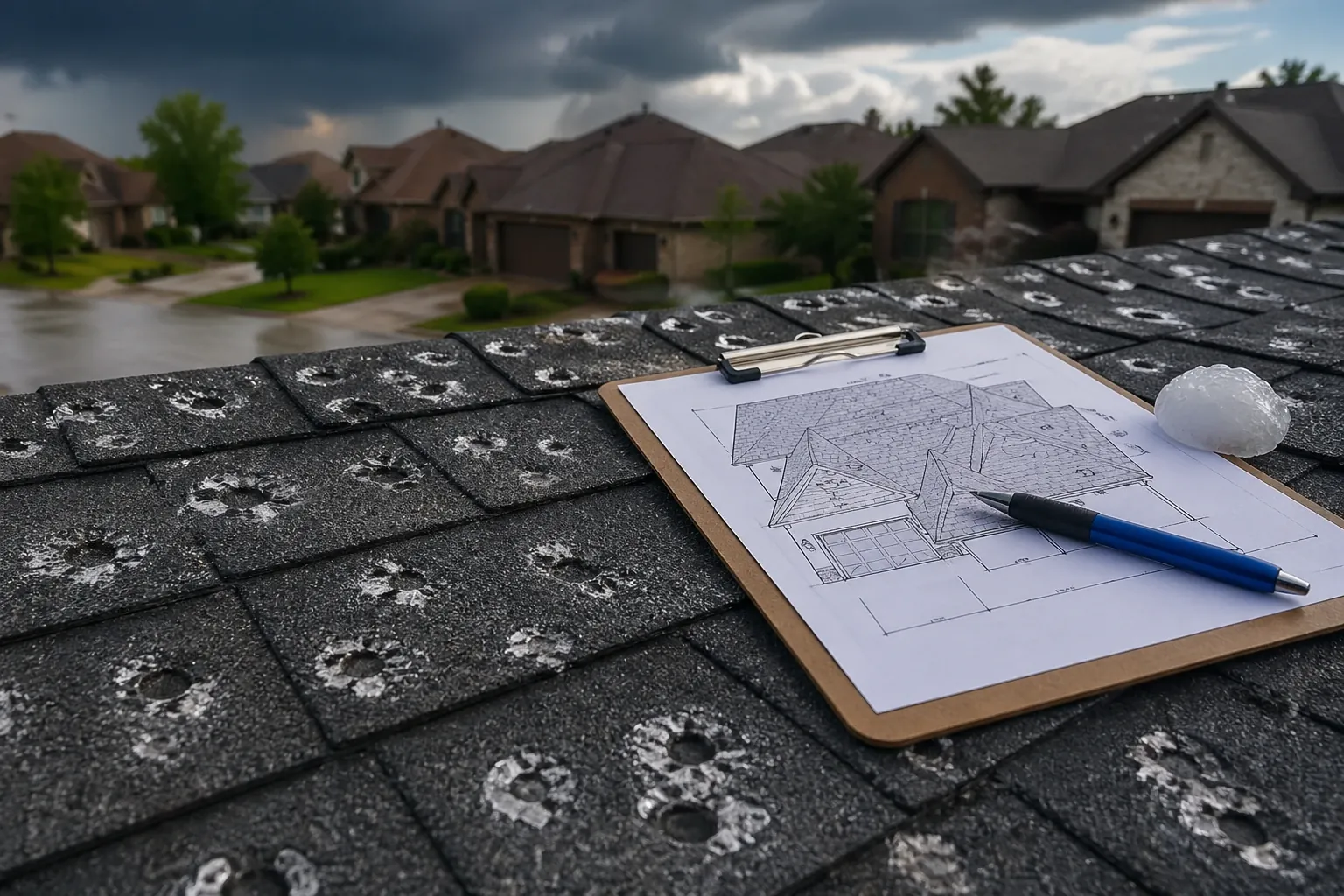
The most common fight in a hail claim is not whether hail hit the roof, but when. Insurers may argue the damage predates the policy, came from an earlier storm, or is simply wear. Evidence that can help tie damage to a specific date:
| Evidence | What it shows |
|---|---|
| NOAA / NWS storm reports | Hail size and location on a specific date |
| Photos of hail on the ground | Stone size and timing, especially with a coin or ruler for scale |
| Fresh marks on soft metals | Bright, unoxidized dents suggest recent impact |
| Prior roof photos or inspections | Condition before the storm (real estate listings and appraisals sometimes help) |
| Neighbor claims and repairs | Pattern of damage across the street or subdivision |
| Radar and storm data | Path of the hail core over the property |
Our storm lookup tool and storm history page draw on NOAA data for Jefferson County.
Policy Terms That Shape a Hail Settlement
- Who covers hail. If your homeowners policy excludes wind and hail, hail damage is a TWIA claim, with TWIA’s own deadlines.
- Wind/hail deductible. Often a percentage of the dwelling limit. A 1% deductible on a $200,000 home is $2,000; a 2% deductible is $4,000.
- Cosmetic damage exclusions. Common on metal roofs; they remove coverage for dents that do not affect function.
- ACV roof coverage or payment schedules. Older roofs may be paid at depreciated value only.
- Matching. Whether undamaged sections must be replaced so materials match varies by policy and facts.
Where Hail Estimates Fall Short
Hail estimates are often written quickly after a storm. Items we frequently see missing or underpriced include:
- Soft metals such as gutters, downspouts, and vents
- AC condenser fin damage
- Window screens and wrapped trim
- Painting of hail-spattered siding or fences
- Roof accessories, drip edge, and code-required items
- Interior water damage from roof punctures
An insurance estimate review can compare the insurer’s scope with the property. If the claim was denied, our denied insurance claims page explains how to ask for a written explanation and what to do next.
What to Do in the First Week After a Hail Storm
Hail damage is easy to put off because the house usually still looks fine from the street. A few steps taken right away make the claim much easier to support later.
- Photograph the hail itself. If stones are still on the ground, take pictures next to a coin, ruler, or tape measure. Note the time.
- Walk the property. Check gutters, downspouts, window screens, the AC condenser, painted wood, fences, outdoor furniture, and vehicles. Fresh dents on soft metals are some of the best evidence you will have.
- Look inside. Check ceilings below the roof and around skylights for new stains over the next few rains.
- Write down the date. Hail storms around Port Arthur often come with severe wind, and knowing the exact date helps later when you match damage to NOAA records.
- Get a close roof inspection. A ground-level look rarely shows bruising or mat fractures. Avoid going on the roof yourself.
- Report the claim promptly to the right insurer, whether that is your homeowners carrier or TWIA.
- Be cautious with door-to-door offers. After a hail storm, contractors may canvass neighborhoods. You can get repair bids, but your insurer and your policy decide the claim.
Owners of commercial and industrial buildings should also check rooftop units, skylights, and the membrane around drains and penetrations, where hail punctures often lead to leaks months later. Our claim documentation checklist has a printable version.
How a Port Arthur Public Adjuster Helps With Hail Claims
A public adjuster represents you. On a hail claim, that may include an inspection with test squares and soft-metal photos, gathering weather data for the date of loss, reviewing the policy for cosmetic and roof endorsements, preparing a line-item estimate, and presenting the claim to the insurer. Port Arthur Public Adjuster is a service of Rise Public Adjusting LLC, TDI license #3356839. Results depend on the policy and facts, and fees are disclosed in a written contract before any work begins; Texas law caps public adjuster compensation at 10% of the insurance settlement.
Hail swaths cross city lines. We serve property owners in Port Arthur, Groves, Nederland, Port Neches, Beaumont, and across Jefferson County and Southeast Texas.
Frequently Asked Questions
Does TWIA cover hail damage in Port Arthur?
Yes. TWIA policies cover windstorm and hail. If your homeowners policy excludes wind and hail, your hail claim is likely a TWIA claim, which TWIA says must be reported within one year from the date of damage.
How can I tell if my roof has hail damage?
From the ground, look for dents in gutters, downspouts, roof vents, mailboxes, and AC condenser fins, and for granules collecting at downspouts. On the roof, hail damage often appears as soft bruises, exposed asphalt, or fractured shingle mats. A close inspection is usually needed to confirm it. Avoid climbing on the roof yourself.
What is a cosmetic damage exclusion?
Some policies, especially those covering metal roofs, exclude dents that do not affect the roof’s ability to shed water. Whether a dent is cosmetic or functional is a frequent point of disagreement. Look for this endorsement in your policy.
The insurer says my hail damage happened before my policy started. Can I prove otherwise?
Dated photos of the roof, prior inspection reports, NOAA storm reports, and the freshness of the marks (bright, unoxidized dents on soft metals) can help show when damage happened. Our storm lookup lists recorded hail events near Port Arthur.
Does hail damage to my car fall under my home policy?
No. Vehicle hail damage is covered, if at all, under the comprehensive part of an auto policy. Your home or TWIA policy covers the structures and, depending on the policy, personal property.
Will a public adjuster guarantee my roof is replaced after hail?
No. A public adjuster can document the damage and present a supported estimate, but the result depends on the damage, the policy, and the insurer’s decision. Fees are disclosed in a written contract before any work begins; Texas law caps public adjuster compensation at 10% of the insurance settlement.